Sunday, April 19, 2026
02:15:29 PM UTC+3 - Addis Ababa

Sunday, April 19, 2026
02:15:29 PM UTC+3 - Addis Ababa
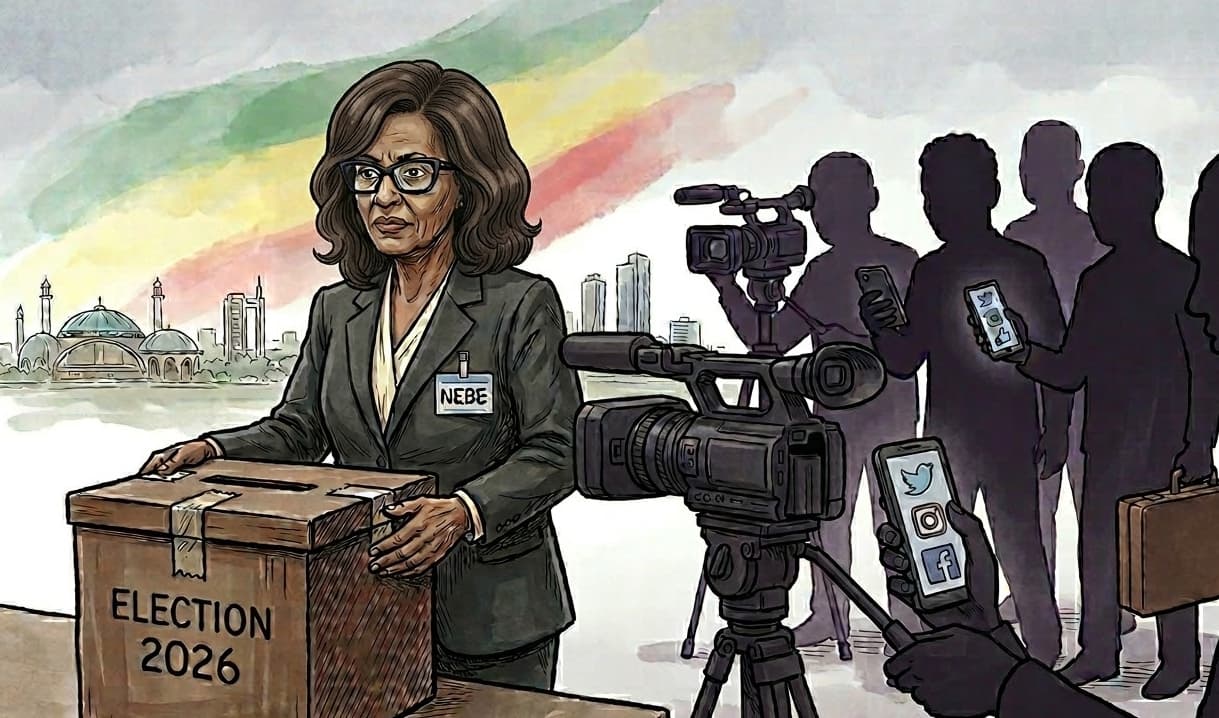
Ethiopia is heading toward a defining political moment.
The upcoming general election, scheduled for 2026, is not merely another entry in the country’s constitutional calendar. It is something far more consequential: a test of whether Ethiopia can produce not just an election, but a legitimate one. Because elections, contrary to popular belief, are not democratic simply because they take place. They are democratic only when they are accepted.
And in Ethiopia today, acceptance—not procedure—is the central challenge.
The country approaches this election under the shadow of unresolved conflict and persistent instability. The aftermath of the Tigray War continues to shape the political and security landscape, with lingering tensions and periodic flare-ups raising concerns about the durability of peace. At the same time, unrest in regions such as Amhara Region and Oromia Region has created pockets where the authority of the state is contested. These are not peripheral issues. They go to the heart of whether a national election can, in fact, be national.
The experience of the 2021 vote looms large. That election, while significant in its own right, was marked by the absence of polling in large parts of the country. Millions were effectively left out of the process, not by choice but by circumstance. If such patterns are repeated, Ethiopia risks holding an election that is national in name but partial in substance. And an election that excludes cannot unify.
Security, in this sense, is not simply a logistical prerequisite. It is the foundation upon which legitimacy rests.
Yet even if ballots are cast across the country, a deeper issue remains. Elections are often reduced to their technical components—voter registration, ballot distribution, vote counting—as if democracy were merely a matter of administrative efficiency. But this technocratic view misses the essential point. Elections are not only about how votes are cast; they are about how the process is perceived. They require trust, inclusion, and the genuine possibility of participation.
In Ethiopia, these elements are under strain. Opposition parties have voiced concerns about the transparency and fairness of the pre-election environment, pointing to obstacles in candidate registration, limited access to media, uneven administrative practices, and harassment and arrests. Whether each claim is fully substantiated is, in some ways, beside the point. What matters is that such perceptions exist and are widely held. In politics, perception often carries as much weight as reality. A process that is seen as unfair will struggle to produce an outcome that is accepted, regardless of how orderly the mechanics may appear.
This challenge is compounded by Ethiopia’s electoral history. Since the introduction of multiparty politics in the early 1990s, the country has struggled to establish a consistent pattern of competitive, credible elections. Political dominance by ruling parties or coalitions has limited the development of a strong opposition culture and weakened public confidence in the electoral process. Each election has carried the burden of those that came before it, and trust—once eroded—has proven difficult to rebuild.
Legitimacy, after all, is cumulative. It is built slowly, over time, through repeated demonstrations of fairness and accountability. And two decades later, Ethiopia is still in the process of constructing that foundation.
Beyond these immediate and historical concerns lies a deeper structural issue rooted in the country’s system of ethnic federalism. Designed to accommodate diversity, it has also entrenched identity as the central axis of political competition. Elections in such a system are rarely just about policy or governance. They are about belonging, representation, and, at times, survival. The stakes are therefore unusually high. Losing an election can be interpreted not merely as a political setback but as a loss of voice, influence, or security.
When politics becomes existential, compromise becomes difficult and acceptance becomes fragile.
Against this backdrop, the question is not whether Ethiopia will hold an election. It will. The question is whether that election will be accepted as genuine and credible across the country’s diverse and divided political landscape.
The answer lies not in the mechanics of Election Day but in the conditions that precede it.
A credible election begins with security, not scheduling. There is a natural inclination, particularly in constitutional systems, to adhere strictly to electoral timelines. Deadlines carry symbolic and legal weight. But when large segments of the population cannot safely participate, the symbolism of punctuality rings hollow. An election held on time but under conditions of insecurity risks producing a result that is neither representative nor legitimate. In such circumstances, difficult decisions may be required, including adjustments to timelines or voting arrangements. These decisions are never easy, but the alternative—an election that excludes significant portions of the population—is far more damaging.
The role of the National Election Board of Ethiopia is equally critical. Its credibility will shape the credibility of the entire process. Independence, however, is not merely a legal designation. It is a perception that must be earned and sustained. Transparency in communication, openness to scrutiny, and active engagement with political actors are essential. In a polarized environment, even minor ambiguities can fuel suspicion. The electoral body must therefore operate not only with neutrality but with visible neutrality.
Equally important is the need to level the political playing field. Elections cannot be credible if one side competes with structural advantages that others cannot match. This does not mean eliminating all disparities—an impossible task—but it does mean ensuring that the rules are applied consistently and fairly. Access to media, freedom of assembly, and the ability to campaign without undue restriction are not privileges. They are prerequisites for meaningful competition. An election without genuine contestation is not an election in the democratic sense; it is a confirmation exercise.
Inclusion must also be prioritized over perfection. In a country as large and complex as Ethiopia, especially under current conditions, a flawless election is unrealistic. But an inclusive one is not. Reaching conflict-affected populations, internally displaced persons, and marginalized communities will require creativity and flexibility. The goal should not be procedural perfection but broad participation. Every effort made to include those on the margins strengthens the legitimacy of the final outcome.
Transparency, meanwhile, must run through every stage of the process. From voter registration to the announcement of results, openness is essential. Citizens must be able to see, understand, and trust how decisions are made and how votes are counted. Independent observation, both domestic and international, can play a valuable role in reinforcing this trust. Technology, if used, must be introduced carefully and communicated clearly, as poorly understood systems can deepen suspicion rather than alleviate it.
Yet even if all these conditions are met, there remains one factor that no institution can fully guarantee: political maturity. Elections ultimately depend on the willingness of political actors to engage in good faith. Those in power must be prepared to accept scrutiny and to operate within the constraints of fair competition. Those in opposition must be prepared to accept results—provided the process is credible. Both sides must resist the temptation to frame politics as a zero-sum struggle in which any loss is intolerable.
In politically diverse societies, the greatest risk is not that one side loses an election. It is that the system itself loses legitimacy.
The true test of Ethiopia’s election will not come on voting day. It will come after. It will be measured in whether losing parties accept the outcome, whether citizens believe their voices were heard, and whether the process contributes to stability rather than tension. These are not technical questions. They are political and psychological ones, rooted in trust.
Ethiopia stands at a crossroads. The upcoming election could mark a step toward democratic consolidation, offering a path toward greater inclusion and stability. Or it could deepen existing fractures, reinforcing cycles of mistrust and contestation.
The difference will not be determined by how many ballots are cast, but by how many people believe those ballots mattered.
Because in the end, democracy is not about voting.
It is about trust.
And trust cannot be manufactured on Election Day. It must be built—patiently, deliberately, and collectively—long before the first vote is cast.
If Ethiopia can do that, the election will be more than an event. It will be a turning point.
If it cannot, then the ballots will be counted, the results will be announced, and the process will move forward.
But the question of legitimacy will remain unanswered.
0 Comments
No comments yet. Be the first to comment!